The renowned SLP Summit is back, and registration is open! 🤩

SLP Summit Details + Registration

The Interconnection Between Feeding and Language Development

This course examines the interconnection between feeding and language development, highlighting how early sensory, motor, and social experiences during feeding lay the groundwork for communication. This course will equip participants with the knowledge and tools needed to help families establish positive feeding and communication routines during infancy and toddlerhood. Practical intervention strategies will be shared that support both feeding and language growth, with a focus on infants and young children from birth to three years.

Explore Course

The Interconnection Between Feeding and Language Development

This course examines the interconnection between feeding and language development, highlighting how early sensory, motor, and social experiences during feeding lay the groundwork for communication.

Feeding is one of the very first motor and social tasks infants engage in, and these experiences play a critical role in shaping the foundations of speech and language development. When feeding skills are supported effectively from the beginning, children are better positioned to thrive in their overall communication and developmental journey.

Participants will explore how developmental milestones in feeding and language overlap during the first three years of life and how disruptions in these processes may affect long-term outcomes. Through evidence-based discussion and practical examples, the course emphasizes the importance of establishing solid foundations in both domains. Special attention will be given to the influence of caregiver–child interactions, highlighting how mealtime experiences, routines, and responsive caregiving can serve as opportunities to foster early communication skills while promoting safe, efficient feeding.

As speech-language pathologists, one of our roles is to aid in the prevention of speech, feeding, and language disorders through education and caregiver coaching. If caregivers are provided with accurate information and effective strategies early in life, this can significantly reduce or even prevent life-long challenges. This course will equip participants with the knowledge and tools needed to help families establish positive feeding and communication routines during infancy and toddlerhood.

Practical intervention strategies will be shared that support both feeding and language growth, with a focus on infants and young children from birth to three years.

Presenters

  •  Emma Justice

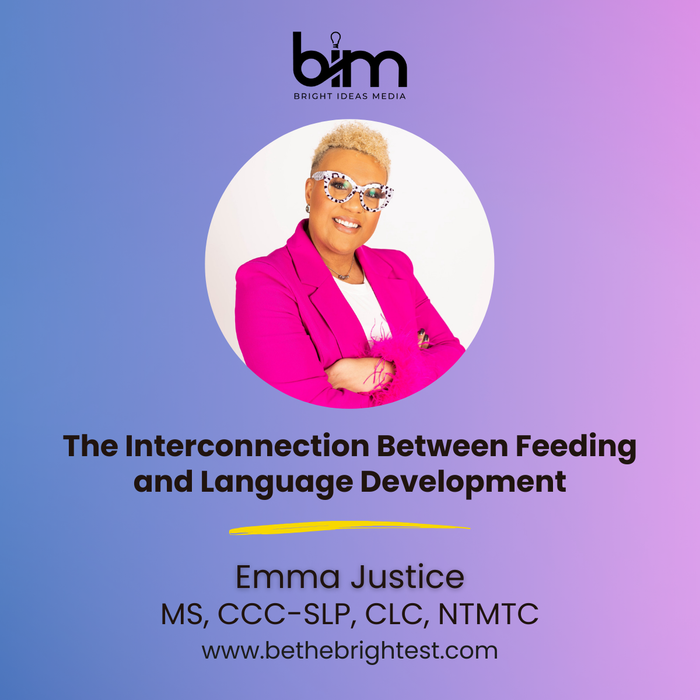
    Emma Justice, MS, CCC-SLP, CLC, NTMTC is a Boston native who earned her undergraduate degree from Bridgewater State University and Master’s degree in Speech-Language Pathology from Northeastern University. She is the owner of Justice for Infant Feeding Therapy and Lactation, specializing in infant and pediatric feeding, swallowing, and early language development, with a particular focus on NICU graduates, culturally diverse populations, and non-traditional families. Through JFI, Emma provides in-home and telehealth services, parent and clinician coaching, as well as online resources and guides such as How to Wean Your Toddler from a Pacifier and more. In addition to running her private practice, Emma works for Boston Public Schools, where she has helped develop district-wide feeding and swallowing policies, and treats pediatric patients at Spaulding Rehabilitation Hospital in outpatient rehab and the special care nursery. Her clinical background includes robust experience across pediatric rehabilitation and acute care hospitals (NICU, PICU, and outpatient therapy settings), where she has supported both feeding and language outcomes for medically fragile patients. She has also earned multiple certifications to advance her expertise in evidence-based assessment, diagnosis, and treatment. Beyond clinical practice, Emma speaks regularly on topics related to pediatric dysphagia, feeding, and equity, and serves as the pediatric consultant for the Swallowing Wellness Center, where she teaches about infant and pediatric swallow studies. She co-created BABY S.T.E.P., with Dr. Ianessa Humbert, a pediatric adaptation of Humbert’s S.T.E.P. (Swallowing Training Education Portal), designed to provide accessible, affordable, and evidence-based swallowing education to clinicians and graduate students. Additionally, she actively contributes to the field and public health through her volunteer roles on Boston’s March of Dimes committee and The Massachusetts Speech and Hearing Association’s Scholarship committee. As a former NICU baby herself, Emma is deeply passionate about social determinants of health, trauma-informed care, breastfeeding advocacy, and language access for marginalized communities.
Learning Objectives

Identify the developmental foundations shared between feeding and language, including oral motor, sensory, and social components.
Describe how early feeding experiences contribute to communication development across infancy and early childhood.
Explain the role of caregiver–child interactions during feeding in fostering language development.
Develop intervention approaches that support safe, efficient feeding while fostering early language growth.

Agenda

Agenda

2 minutesIntroduction, Course Overview and Learning Objectives
13 minutesPrenatal Development: early sensory and motor foundations for feeding and communication
15 minutesInfant communication, feeding skills and connection
15 minutesDevelopmental milestones in feeding and language: overlapping pathways and prevention
10 minutesCaregiver–child Interactions and interventions during mealtimes to support language growth
5 minutesCourse wrap up 

Disclosures

Disclosures

Financial:Emma is receiving an honorarium for this presentation. She is the owner of Justice For Infant Feeding Therapy and Lactation, receives a salary from Boston Public Schools and is paid per diem through Spaulding Rehabilitation Hospital. Additionally Emma receives royalties for her development of Baby S.T.E.P ( Swallowing Training Educational Portal) and receives a consulting fee from the Swallowing Wellness Center.
Non-Financial:Emma has no non-financial relationships to disclose.
Content:Emma has no additional content information to disclose.

ASHA

ASHA

This course is offered for .1 ASHA CEUs, Intermediate Level, Professional Area

To earn ASHA CEUs you must complete the courses by viewing them, provide course feedback, pass the exams with a score of 80 or more, provide your ASHA credentials, and confirm submission.

Customer Reviews

The Interconnection Between Feeding and Language Development Active
$29.00
This course examines the interconnection between feeding and language development, highlighting how early sensory, motor, and social experiences during feeding lay the groundwork for communication. This course will equip participants with the knowledge and tools needed to help families establish positive feeding and communication routines during infancy and toddlerhood. Includes access to the recorded course and optional ASHA reporting.

Add-ons

Wait, I can bill for feeding and language simultaneously?
$15.00
This course equips speech-language pathologists with practical strategies for billing feeding and language services delivered in the same session. Participants will learn coding guidelines, ethical considerations, and documentation practices to maximize reimbursement while maintaining compliance and quality care. Includes access to the recorded course and optional ASHA reporting.